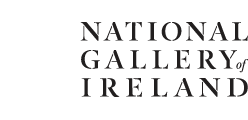
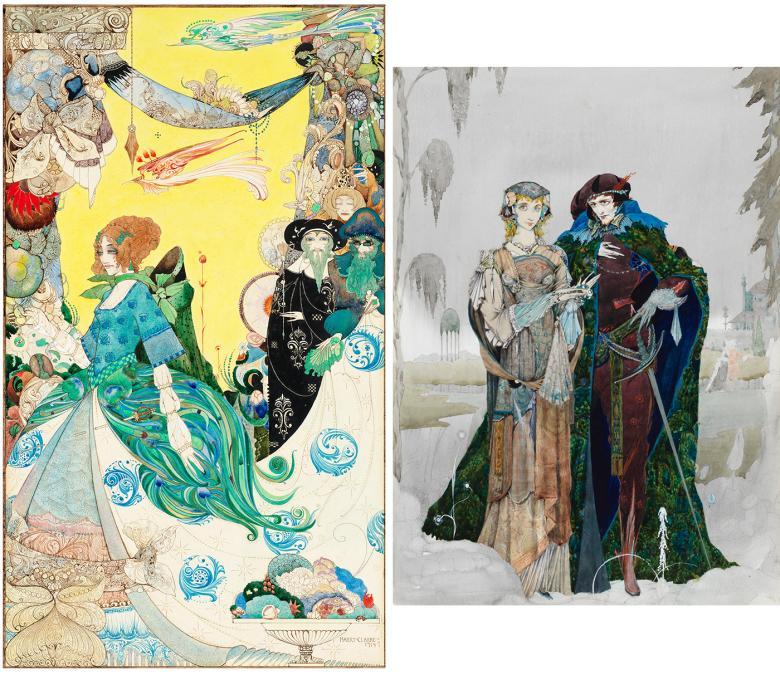
- The Lady of the Decoration, 1914, and Faust, 1924/25 acquired by the Gallery
- The acquisition is supported by the National Gallery of Ireland’s Patrons of Irish Art and the Department of Culture, Communications and Sport
Two of Irish artist Harry Clarke’s illustrations have become part of the national collection at the National Gallery of Ireland. Faust, 1924/25, and The Lady of the Decoration, 1914, now belong to the Irish public. The acquisitions were supported by the Patrons of Irish Art of the National Gallery of Ireland, whose membership fees support acquisitions of Irish art.
Born in Dublin on St Patrick’s Day in 1889, Harry Clarke is one of Ireland’s best known and most beloved artists. He achieved significant acclaim in his short lifetime, working across different media including book illustration. His principal career was in the production of stained glass windows, mainly for churches and religious houses across Ireland, as well as in the UK, US and Australia.
In 1913 at aged 24, Clarke was given his first major book illustration commission by Harrap’s of London to design plates for a luxury edition of Hans Christian Andersen’s Fairy Tales (1914), launching his career as a book illustrator. He subsequently provided designs for Poe’s Tales of Mystery and Imagination (1919), The Fairy Tales of Perrault (1922) and Anster’s translation of Goethe’s Faust (1925). Despite his success in this arena, Clarke focused his abilities on stained glass design, eventually taking over his father’s business in North Frederick Street, Dublin. Notable works by Clarke in stained glass include windows for the Honan Chapel (University College Cork), and the Geneva Window (Wolfsonian Institute, Miami). Clarke’s work, in whatever media, displays a refined handling and exceptional technical skill.
The Lady of the Decoration, 1914
Clarke produced The Lady of the Decoration for reproduction as a colour lithograph on a calendar. It was commissioned by John Duthie of Glasgow, a paint supplier and friend of Clarke’s father Joshua. The work is a large-scale masterwork, featuring characteristic fantastical figures, sophisticated decorative elements and a vibrant colour range. It seems certain, from the distinctive nature of the title and detail of the illustration itself, that Clarke derived the subject from a popular novel of the same name by Frances Little, first published in New York in 1907. The book recounts the experiences of a young woman travelling in Japan and outlines her journey from uncertainty to self-discovery. Clarke balances areas of overlaid pattern and colour with calmer sections, including the blue patterned white train and the unembellished, vivid lemon yellow area in the centre.
This superb example of Harry Clarke’s graphic work complements his illustrations made for Harrap’s 1914 publication of Hans Christian Andersen’s Fairy Tales, which are already in the national collection at the Gallery.
Faust, 1924/25
This exquisitely detailed drawing relates to Clarke’s final commission from the London publisher Harrap’s to provide illustrations for John Anster’s English translation of Goethe’s Faust, published in 1925. Although this piece did not feature in the final edit of the book, it is as richly coloured and exquisitely detailed as the other works in the series. In the drawing, the book’s protagonist Faust walks through the garden of the wealthy Dame Schwerdtlein with Marguerite, the innocent subject of his affection. The two appear as if on stage, standing out against a background reminiscent of the popular theatre backdrops with which Clarke was familiar. The artist pays typical attention to the characters’ clothing, highlighting the various patterns and weights of velvet, silk and lace through the use of finely graduated colour and precise line.
This watercolour shows Clarke at the height of his powers as an illustrator. The subject, the same as that chosen by Frederic William Burton for his iconic watercolour Faust’s First Sight of Marguerite, also part of the national collection, shows how certain works of literature were revisited and reworked by visual artists over generations.
Dr Caroline Campbell, Director of the National Gallery of Ireland, said: “As the holiday season approaches, it is wonderful to add these beautiful illustrations by Harry Clarke to the national collection. The works we hold by Harry Clarke are some of the most popular objects in our collection, so we know that our visitors – from home and afar – will love ‘Faust’ and ‘The Lady of the Decoration’. I’m thrilled that we have been able to acquire these exquisite drawings, and I thank our Patrons of Irish Art for their generous contributions to these acquisitions, and the Department of Culture, Communications and Sport for their ongoing support.”
Through new acquisitions and conservation, the National Gallery of Ireland develops and preserves the nation’s art collection and is committed to collecting high quality work by key figures in the story of Irish art. With extensive exhibitions, public programmes, community engagement, education and outreach work, the Gallery further commits to its role as a caretaker of creativity and imagination. The Gallery thanks and celebrates the role of its supporters, including the Patrons of Irish Art.
There are five opportunities for those who would like to support us as a Patron of the National Gallery of Ireland. Each level of patronage offers a unique and personalised Gallery experience, fantastic benefits and dedicated events. Our Patrons can also enjoy all the privileges of our Friends of the National Gallery of Ireland programme. Every Patron will be contributing to the acquisition of Irish works of art. For further information, please visit https://www.nationalgallery.ie/join-and-give/patrons-programme.
The Gallery would like to thank the Department of Culture, Communications and Sport for its ongoing support.
Find out more at www.nationalgallery.ie.
ENDS
Notes to the editor:
- Dr Caroline Campbell, Director of the National Gallery of Ireland, is available for interview.
Media contacts:
Sam Hardiman, Communications Coordinator: Press & Advertising, [email protected]
Gallery opening hours:
Monday: 11am – 5.30pm
Tuesday – Wednesday: 9.15am – 5.30pm
Thursday: 9.15am – 8.30pm
Friday – Saturday: 9.15am –5.30pm
Sunday: 11am – 5.30pm
About the artist:
Harry Clarke (1889-1931) was a leading exponent of the Celtic Revival and of the Irish Arts and Crafts movement at the beginning of the 20th century. Attracted by the artistic language of the Symbolists, he created in that style innumerable beautiful images derived from literature, medieval legends and religious sources. Extremely talented, his ability was equally impressive in different media, but his greatest success was achieved as a book illustrator and stained-glass artist.
Harry Clarke left school early and began working for his father’s business, meanwhile taking night classes in stained glass at the Dublin Metropolitan School of Art. Clarke worked as a book illustrator, publishing his first designs in 1916, illustrations for Fairy Tales by Hans Christian Anderson (of which the National Gallery of Ireland holds ten original colour drawings). His reputation as an artist of considerable talent was established when in 1919 he published his black and white illustrations for Edgar Allen Poe’s Tales of Mystery and Imagination.
His principal career was in the production of stained glass windows and he fulfilled forty commissions for churches and religious houses throughout Ireland, beginning with the windows for the Honan Chapel in Cork (1915-1917) and fifteen commissions for the UK, the US and Australia. Upon the death of his father in 1921, he inherited the stained glass business at North Frederick Street, renaming it ‘Harry Clarke Studios’. In addition to ecclesiastical design, Clarke undertook secular commissions often inspired by literature, the most famous being The Geneva Window (1926-1930).
In 1929 Clarke was struck down by tuberculosis and travelled to a sanatorium in Davos, Switzerland, to attempt to recuperate. Conscious of his deteriorating physical state and fearful that he would die abroad, he attempted to make his way back to Ireland. He died on 6 January 1931 in Chur, Switzerland, where he is buried. Beloved husband of Margaret (Crilly) Clarke (1884-1961), the Harry Clarke Studios continued under Margaret’s helm and operated until 1973.
About the National Gallery of Ireland:
The National Gallery of Ireland is one of the country’s most popular visitor attractions housing the nation’s collection of European and Irish art from about 1300 to the present day, and an extensive Library & Archive. Entry to the collection is free for all to enjoy, learn and be inspired.
For More Information:
Visit nationalgallery.ie or follow us on social media:
- Facebook & Instagram: @nationalgalleryofireland
- Twitter: @NGIreland
- LinkedIn: @National Gallery of Ireland
Dhá shaothar le Harry Clarke faighte ag Gailearaí Náisiúnta na hÉireann don bhailiúchán náisiúnta
Tá ‘The Lady of the Decoration’, 1914, agus ‘Faust’, 1924/25
Ceannaíodh na saothair sin le tacaíocht ó Phátrúin na hEalaíne Éireannaí ag Gailearaí Náisiúnta na hÉireann agus ón Roinn Cultúir, Cumarsáide agus Spóirt
Tá dhá shaothar le Harry Clarke curtha leis an mbailiúchán náisiúnta i nGailearaí Náisiúnta na hÉireann. Is le muintir na hÉireann anois Faust, 1924/25, agus The Lady of the Decoration, 1914. Ceannaíodh iad le tacaíocht ó Phátrúin na hEalaíne Éireannaí ag Gailearaí Náisiúnta na hÉireann, dream a gcuidíonn a dtáillí ballraíochta linn saothair Éireannacha a cheannach.
I mBaile Átha Cliath a rugadh Harry Clarke ar Lá Fhéile Pádraig 1889. Tá sé ar dhuine de na healaíontóirí is cáiliúla agus is mó a bhfuil gean orthu in Éirinn. Cé go bhfuair sé bás agus é fós óg, bhí clú agus cáil bainte amach aige ag obair i meáin éagsúla, agus maisiú leabhar ina measc. Ba é a phríomhghairm bheatha ná fuinneoga daite a dhéanamh, go háirithe d’eaglaisí agus do thithe reiligiúnacha ar fud na hÉireann, agus sa Ríocht Aontaithe, sna Stáit Aontaithe agus san Astráil.
In 1913, agus é 24 bliana d’aois, thug Harrap’s, foilsitheoir i Londain, a chéad choimisiún mór dó nuair a d’iarr siad air leabhar a mhaisiú. Is éard a bhí i gceist leis sin plátaí a dhearadh i gcomhair eagrán galánta den leabhar Fairy Tales (1914) le Hans Christian Andersen. Leis sin, bhí tús curtha lena ghairm mar mhaisitheoir leabhar. Ina dhiaidh sin, rinne sé léaráidí do Tales of Mystery and Imagination (1919) le Edgar Allan Poe, The Fairy Tales of Perrault (1922) agus don aistriúchán a rinne Anster ar Faust le Goethe (1925). Cé go raibh ag éirí go geal leis agus é ag maisiú leabhar, bheartaigh Clarke díriú ar ghloine dhaite a dhearadh, agus tar éis tamaill ghlac sé ar láimh an gnólacht a bhí ag a athair i Sráid Fhreidric Thuaidh, Baile Átha Cliath. I measc na bhfuinneog is tábhachtaí a rinne Clarke as gloine dhaite tá cinn do Shéipéal Uí Eonáin (Coláiste na hOllscoile, Corcaigh), agus The Geneva Window (Institiúid Wolfsonian, Miami). Léiríonn gach saothar le Clarke, beag beann ar an meán, sainchumas láimhseála agus scileanna teicniúla den scoth.
The Lady of the Decoration, 1914
Tharraing Clarke The Lady of the Decoration ionas go bhféadfaí é a chóipeáil mar liteagraf daite ar fhéilire. Ba é John Duthie as Glaschú, soláthróir péinte agus cara le Joshua, athair Clarke, a bhronn an coimisiún air. Sárshaothar ar mhórscála is ea é, ina bhfuil cuid de shaintréithe a chuid ealaíne le sonrú: fíoracha fantaiseacha, eilimintí sofaisticiúla maisiúcháin agus dathanna beoga. Is fianaise iad an teideal sainiúil agus mionsonraí na léaráide féin go raibh Clarke ag tarraingt ar úrscéal móréilimh den ainm céanna le Frances Little, a foilsíodh den chéad uair i Nua-Eabhrac sa bhliain 1907. Faoi bhean óg atá ag taisteal sa tSeapáin atá an leabhar, agus insítear ann scéal a haistir ón éiginnteacht go haithne cheart a chur uirthi féin. Tá codanna den íomhá ina bhfuil na patrúin agus na dathanna sa mhullach ar a chéile agus codanna eile atá socair, séimh, ar nós scofall bán an ghúna lena phatrún gorm agus lár an phictiúir, atá ar dhath gléineach buí na líomóide, gan patrún ar bith.
Is eiseamláir iontach é seo d’obair ghrafach Harry Clarke agus gabhann sé leis na léaráidí a rinne sé do Harrap’s i gcomhair an leabhair Fairy Tales le Hans Christian Andersen in 1914, léaráidí atá sa bhailiúchán náisiúnta ag an nGailearaí cheana féin.
Faust, 1924/25
Líníocht thar a bheith mionsonraithe é seo a tháinig ón gcoimisiún deiridh a fuair Clarke ó Harrap’s, comhlacht foilsitheoireachta i Londain, nuair a iarradh air léaráidí a chur ar fáil d’aistriúchán Béarla a rinne John Anster ar Faust le Goethe, leabhar a foilsíodh in 1925. Cé nach raibh an líníocht seo le feiceáil sa leagan deiridh den leabhar, níl pioc idir é agus na saothair eile sa tsraith ó thaobh shaibhreas na ndathanna agus áilleacht na mionsonraí de. Feicimid Faust, príomhcharachtar an leabhair, agus é ag siúl trí ghairdín an Bhantiarna Schwerdtlein, bean a bhfuil airgead mór aici, in éineacht le Marguerite, ógbhean shoineanta a bhfuil sé i ngrá léi. Tá an bheirt mar a bheidís ar ardán, os comhair cúlra a mheabhraíonn dúinn cúlbhrait na ndrámaí móréilimh a raibh cur amach ag Clarke orthu. Mar is iondúil leis, tugann an t-ealaíontóir an-aird ar éadaí na gcarachtar, agus baineann sé úsáid as dath mínchéimnithe agus línte beachta chun an tsúil a dhíriú ar phatrúin agus meáchain éagsúla na veilbhite, an tsíoda agus an lása.
Bhí Clarke faoi lánseol mar mhaisitheoir leabhar nuair a tharraing sé an pictiúr seo. Is ionann ábhar dó agus Faust’s First Sight of Marguerite, pictiúr uiscedhatha íocónach le Frederic William Burton, atá sa bhailiúchán náisiúnta freisin. Feicimid anseo an chaoi a ndeachaigh amharcealaíontóirí ar ais chuig saothair litríochta áirithe agus ar thug siad faoi léaráidí úra a dhéanamh le gabháil leo.
Arsa an Dr Caroline Campbell, Stiúrthóir Ghailearaí Náisiúnta na hÉireann: “Agus an Nollaig ag teannadh linn, tá an-ríméad go deo orainn na léaráidí áille seo le Harry Clarke a chur leis an mbailiúchán náisiúnta. Tagann na sluaite daoine chun breathnú ar na saothair le Harry Clarke atá againn cheana, agus mar sin táimid cinnte go mbeidh cuairteoirí ó i gcéin is i gcóngar iontach sásta le ‘Faust’ agus ‘The Lady of the Decoration’. Tá áthas orm gur éirigh linn na líníochtaí gleoite seo a fháil, agus gabhaim buíochas le Patrúin na hEalaíne Éireannaí as cuidiú linn, agus leis an Roinn Cultúir, Cumarsáide agus Spóirt as an tacaíocht a thugann sí dúinn i gcónaí.”
Trí shaothair a cheannach agus trí obair chaomhnaithe, forbraíonn agus caomhnaíonn Gailearaí Náisiúnta na hÉireann bailiúchán ealaíne na tíre agus tá sé meáite ar shaothair ardchaighdeáin le healaíontóirí mór le rá na hÉireann a chur leis an mbailiúchán. Le taispeántais fhairsinge, cláir phoiblí, rannpháirtíocht leis an bpobal, agus scéimeanna oideachais agus for-rochtana, féachann an Gailearaí le cur leis an ról atá aige agus é i bhfeighil na cruthaitheachta agus na samhlaíochta. Gabhann an Gailearaí buíochas lena lucht tacaíochta, agus Pátrúin na hEalaíne Éireannaí ina measc, agus is mór aige an ról atá acu.
Tá cúig dheis éagsúla ann dóibh siúd ar mhaith leo tacú linn mar dhuine de Phátrúin Ghailearaí Náisiúnta na hÉireann. Tá baint shainiúil leis an nGailearaí ag gabháil le gach leibhéal pátrúnachta, chomh maith le buntáistí iontacha agus imeachtaí ar leith. Bíonn na buntáistí céanna ag na Pátrúin agus a bhíonn ag Cairde Ghailearaí Náisiúnta na hÉireann. Beidh gach Pátrún ag cuidiú linn saothair ealaíne Éireannacha a cheannach. Le haghaidh tuilleadh eolais, téigh go dtí https://www.nationalgallery.ie/join-and-give/patrons-programme.
Ba mhaith leis an nGailearaí buíochas a ghabháil leis an Roinn Cultúir, Cumarsáide agus Spóirt as an tacaíocht a thugann sí dúinn.
Tuilleadh eolais: www.nationalgallery.ie.
CRÍOCH
Nótaí don eagarthóir:
- Tá íomhánna de na saothair le feiceáil anseo.
- Féadfar an Dr Caroline Campbell, Stiúrthóir Ghailearaí Náisiúnta na hÉireann, a chur faoi agallamh.
Teagmhálaithe na meán:
- Sam Hardiman, Comhordaitheoir Cumarsáide: Preas agus Fógraíocht, [email protected]
Uaireanta oscailte an Ghailearaí:
Dé Luain: 11am – 5.30pm
Dé Máirt – Dé Céadaoin: 9.15am – 5.30pm
Déardaoin: 9.15am – 8.30pm
Dé hAoine – Dé Sathairn: 9.15am –5.30pm
Dé Domhnaigh: 11am – 5.30pm
Eolas faoin ealaíontóir:
Bhí Harry Clarke (1889-1931) ar dhuine de dhíograiseoirí na hAthbheochana Ceiltí agus na gluaiseachta Ealaíon agus Ceardaíochta in Éirinn ag tús an 20ú haois. Mheall cur chuige na nEalaíontóirí Siombalacha é agus bhain sé leas as an stíl chéanna sin chun an-chuid íomhánna áille a tharraingt, íomhánna a bhí bunaithe ar shaothair litríochta, finscéalta ó na meánaoiseanna agus foinsí reiligiúnacha. Fear thar a bheith cumasach ab ea Clarke, agus bhí an-scil go deo aige i meáin éagsúla, ach ba mar mhaisitheoir leabhar agus mar ealaíontóir gloine daite a bhain sé clú agus cáil amach.
D’fhág Harry Clarke an scoil go luath agus thosaigh sé ag obair do ghnólacht a athar. Ag an am céanna bhí sé ag freastal ar ranganna oíche agus é ag foghlaim cheird na gloine daite i Scoil Ealaíne Chathrach Bhaile Átha Cliath. Thug sé faoi leabhair a mhaisiú agus foilsíodh a chéad léaráidí in 1916 in eagrán de Fairy Tales le Hans Christian Anderson (as a measc siúd, tá deich líníocht dhaite bhunaidh i seilbh Ghailearaí Náisiúnta na hÉireann). Ba léir don saol mór go raibh bua na healaíne aige nuair a foilsíodh a chuid léaráidí dubh agus bán i gcomhair Tales of Mystery and Imagination le Edgar Allen Poe in 1919.
Ba é déanamh na bhfuinneog daite a phríomhghairm bheatha agus thug sé i gcrích daichead coimisiún d’eaglaisí agus do thithe reiligiúnacha ar fud na hÉireann, ag tosú le fuinneoga Shéipéal Uí Eonáin i gCorcaigh (1915-1917) agus cúig choimisiún déag sa Ríocht Aontaithe, sna Stáit Aontaithe agus san Astráil. Nuair a fuair a athair bás in 1921, ba chuig Harry a chuaigh an gnólacht gloine daite i Sráid Fhreidric Thuaidh, nó Stiúideonna Harry Clarke mar a tugadh air ó shin i leith. Chomh maith le dearadh eaglasta, thug Clarke faoi shaothair thuata, agus cuid mhaith acu bunaithe ar phíosaí litríochta. Is é The Geneva Window (1926-1930) an saothar is cáiliúla díobh siúd.
In 1929, bhuail an eitinn Clarke agus chuaigh sé go sanatóir in Davos na hEilvéis agus cóir leighis á lorg aige. Bhí a fhios aige go raibh a shláinte ag dul in olcas agus bhí faitíos air go dtiocfadh an bás suas leis agus é fós thar lear. Rinne sé iarracht filleadh ar Éirinn ach fuair sé bás ar an 6 Eanáir 1931 in Chur, san Eilvéis, agus is ansin a cuireadh é. Bhí sé pósta le Margaret (Crilly) Clarke (1884-1961), agus bhí Stiúideonna Harry Clarke fós ar an bhfód, faoi stiúir Margaret ar dtús, go dtí 1973.
Maidir le Gailearaí Náisiúnta na hÉireann:
Tagann na sluaite daoine chuig Gailearaí Náisiúnta na hÉireann. Is ann atá bailiúchán de shaothair ealaíne ón Eoraip agus ó Éirinn, a chlúdaíonn tréimhse ó thart ar 1300 go dtí an lá inniu, chomh maith le Leabharlann agus Cartlann fhairsing. Ní ghearrtar aon táille as cuairt a thabhairt ar an mbailiúchán agus tá súil againn go mbainfidh gach duine taitneamh as, go bhfoghlaimeoidh siad uaidh agus gur spreagadh a bheidh ann dóibh.
Eolas Breise:
Tabhair cuairt ar nationalgallery.ie nó lean muid ar na meáin shóisialta:
- Facebook & Instagram: @nationalgalleryofireland
- Twitter: @NGIreland
- LinkedIn: @National Gallery of Ireland
-

Drawing Inspiration: Harry Clarke (1889-1931)
An illustration of The Travelling Companion fairy tale.
-

Margaret Clarke (1884–1961)
Margaret Clarke (1884–1961)
-

Turner as Inspiration
1-31 January 2026