Tuesdays, 6pm, 12 January to 9 March 2027
(dates 12, 19, 26 Jan, 2, 9, 23 Feb, 2, 9 Mar – no session on 16 Feb)
Book tickets here.
Ticket information
Now on exclusive presale for Friends of the National Gallery of Ireland until 1 December.
Tickets: €150 per course
20% discount for Friends of the Gallery
10% discount Over 65’s/unwaged/students/teachers
Special offer: Benefit from a further 10% discount when all three courses booked together.
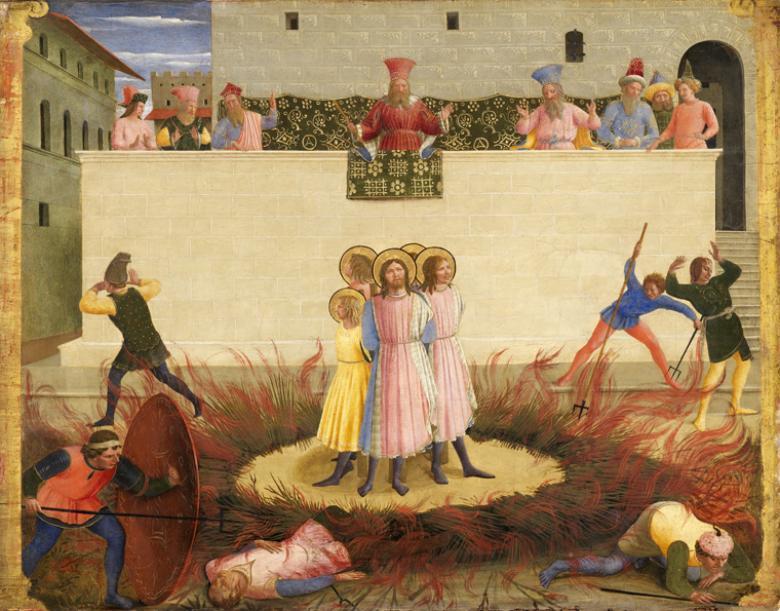
Colour is intimately tied to our knowledge, understanding and enjoyment of visual art. Having experienced works by Caravaggio or Vermeer, for example, we remember the stark contrast between light and dark, or the soft, golden light that falls through a window: the carefully chosen blues in Monet’s depiction of the water at Argenteuil, or Hellelil’s dress; the contrasting greens and whites of William John Leech’s convent garden; or Evie Hone’s use of strong, primary colours for her glass panels. Even when used at its most minimal - think of the pure black line of an etching for example - or white chalk on blue paper, colour is intrinsic to the artwork. For the artist, and for the viewer of artworks, ‘colour’ can be understood as a material, encompassing a variety of pigments in different media, and also as a science: for centuries, artists have contributed to and drawn on the work of colour theory and colour science, responding to changing understandings of how colour is formed and perceived.
Through a series of eight online talks, this course will explore the vibrant history of colour and its role in the history of art. Exploring a wide variety of art historical contexts, but focused on the National Gallery of Ireland’s own collection, the sessions will consider the origins of colour (examining, for example, how different colours are made from natural and synthetic materials); ideas around the perception of colour (such as how colour can impact emotion and experience); and artists’ changing understanding and use of colour theory in their compositions. These themes are framed by the wider history of how art materials were fabricated and circulated through the modern world: this is also a story of port cities, trade networks, and the rise of commercial outlets and new audiences for creative endeavour.
About the tutor
Kathryn Milligan is Assistant Librarian at the Edward Murphy Library, National College of Art and Design, Dublin. As an art historian specializing in nineteenth- and twentieth-century Irish art, Kathryn’s main research focus is on the depiction of Dublin and the city as a site of exhibition, display, and artistic exchange, as well as histories of Irish and European art more generally. Recent publications include essays on nineteenth-century exhibition culture, the White Stag Group, C. P. Curran’s artistic friendships, and Walter Osborne’s domestic paintings. Her first monograph, Painting Dublin, 1886–1949: Visualising a Changing City, was published by Manchester University Press in 2020. Recently, Kathryn was the co-curator of the exhibition Casimir Markievicz: A Polish Artist in Bohemian Dublin, 1903 - 1913 held at the State Apartment Galleries, Dublin Castle.
View the other 2027 courses:
-

Take a Closer Look: Online Art Appreciation Courses 2027
Online art appreciation courses
-

Into the West: Artists inspired by the West of Ireland with Jessica Fahy
The spring online art appreciation course
-

War and Rebellion – Conflict in Art with Dr Sarah Wilson
The autumn online art appreciation course