
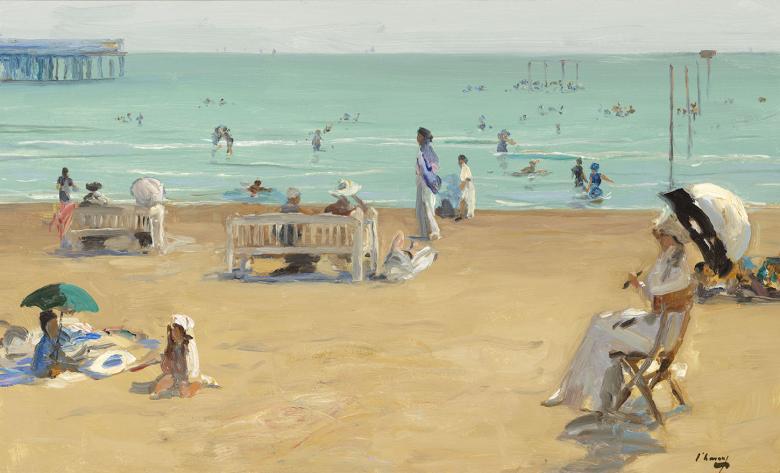
A new addition to the collection, Sir John Lavery's The Bathing Hour, the Lido, Venice (1912) has joined the collection and is now on display in Room 16.
Belfast-born artist John Lavery visited Venice in September 1912, two years after he exhibited at the Biennale there. Although he had made several visits to the city, this trip marked the first occasion on which he stayed on the Lido, an 11-kilometre-long barrier island in the Venetian Lagoon. As was common practice for Lavery, he packed his travelling easel for this visit. Unlike many of his peers, who focussed on the newly reconstructed Campanile in St Mark’s Square, Lavery directed his attention to life on the beach in front of the Hotel Excelsior, the same location that inspired Thomas Mann’s book of the same year, Der tod in Vendig (Death in Venice) (1912).
If you visited our 2023/2024 exhibition, Lavery. On Location, you’ll recognise this painting. One of the highlights of that exhibition, we are very pleased to have now added it to the national collection, deepening our representation of one of Ireland’s most beloved and influential artists.
About Sir John Lavery R.A., R.S.A., R.H.A. (1856-1941)
The son of a wine and spirit merchant, Lavery spent his early years in his native Belfast, but moved to Scotland when orphaned at the age of three. Having lived with relatives at various locations, he took a job with a photographer in Glasgow and began attending evening classes at the Haldane Academy of Art. He subsequently moved to London, and in turn to Paris to continue his studies, enrolling at the fêted Académie Julian. From Paris he moved on to the artists’ colony at Grez-sur-Loing. Like contemporaries from throughout Europe, Lavery was inspired by the work of Jules Bastien-Lepage, and his early French paintings possessed many of the distinguishing characteristics of Rustic Naturalism.
A pivotal moment in Lavery’s career took place after his return to Scotland when, in 1888, he received a commission to paint the visit of Queen Victoria to the Glasgow International Exhibition. Over the following decades, Lavery established himself as one of the foremost portrait painters among the social elite in Europe, and continued to travel throughout Europe, North Africa and beyond. Lavery arrived in Venice to paint this work in September 1912 after a particularly busy year. Having been elected an Associate of the Royal Academy, he completed a series of portraits of the Russian ballerina Anna Pavlova, accommodated many other portrait sittings, and executed an imposing portrait of the Royal Family (now in the National Portrait Gallery, London).
The acquisition of The Bathing Hour, the Lido, Venice (1912) by the Gallery was enabled by Section 1003 of the Taxes Consolidation Act, 1997, which provides a tax relief in respect of the donation of important national heritage items to the Irish national collections.
See it in Room 16 on your next visit.
You might also like:
-

Harry Clarke
The Lady of the Decoration and Faust
-

Sunday Evening, Place du Combat, Paris (1937) by Harry Kernoff
A keen observation of Paris Café life
-

Ruth by David Booth
By David Booth
-

Landscape with Cottages and a Hay Barn (1641)
A new acquisition by Rembrandt van Rijn