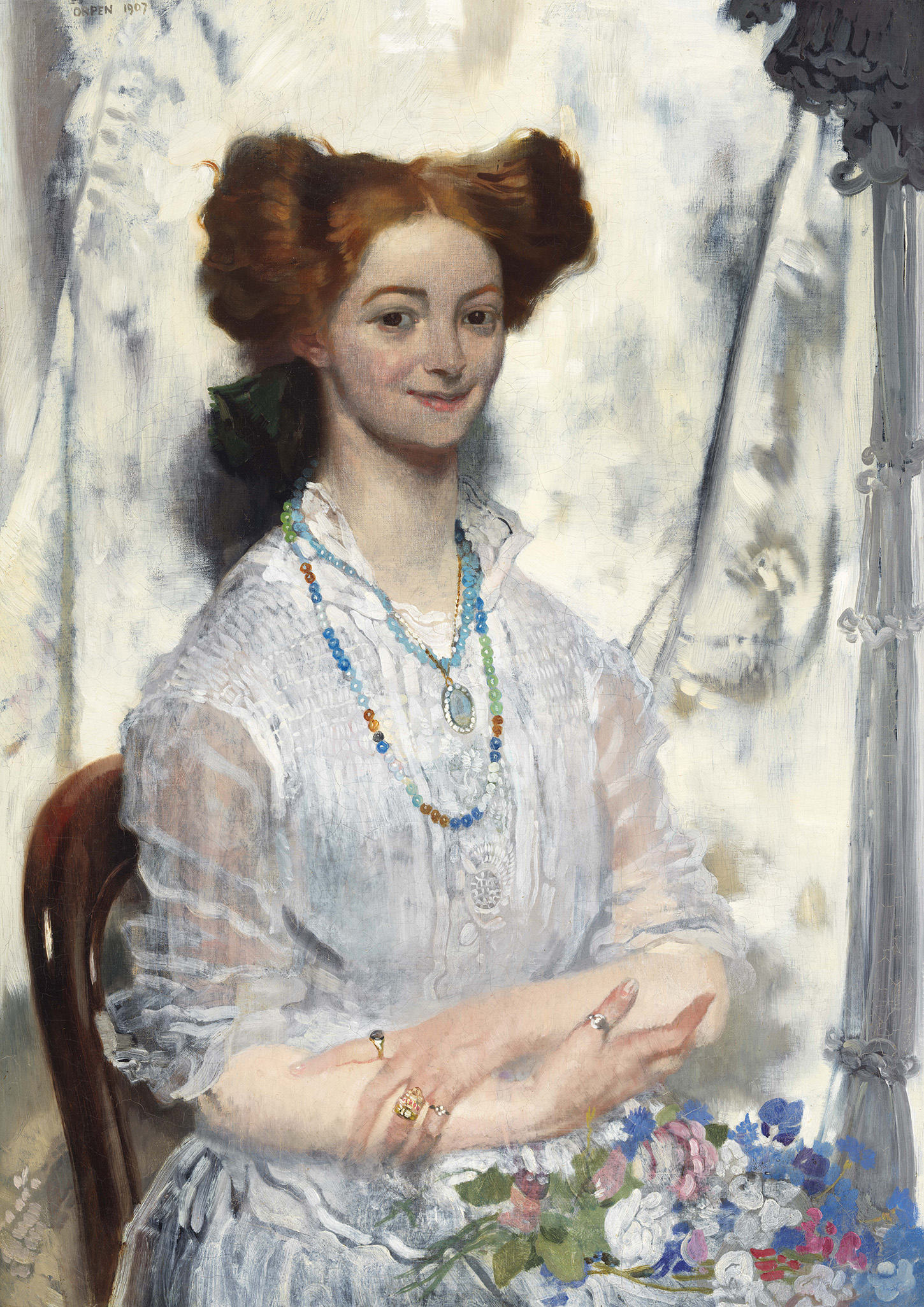
 William Orpen, Young Ireland. Photo, National Gallery of Ireland.
The National Gallery of Ireland announces the acquisition of two new works:
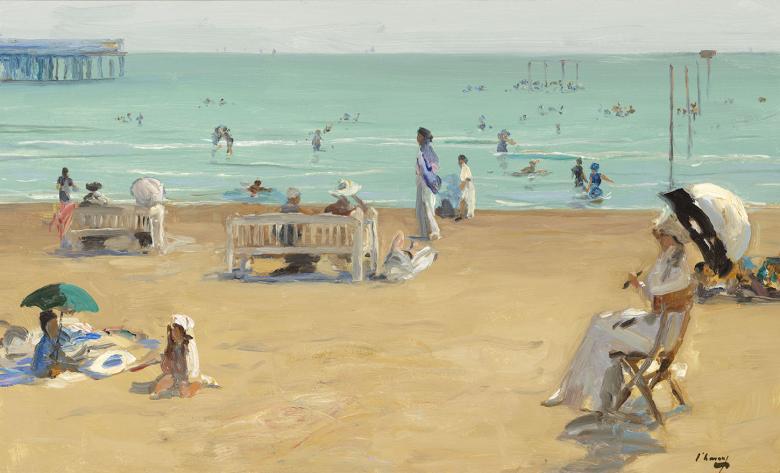
John Lavery’s The Bathing Hour, the Lido, Venice (1912)
William Orpen’s Young Ireland (1907)
The National Gallery of Ireland is proud to announce the acquisition of The Bathing Hour, the Lido, Venice (1912), by John Lavery (1856-1941) and Young Ireland (1907) by William Orpen (1878-1931). These significant additions to the national collection deepen the Gallery’s representation of two of Ireland’s most beloved and influential artists. The acquisition of The Bathing Hour, the Lido, Venice (1912) by the Gallery was enabled by Section 1003 of the Taxes Consolidation Act, 1997, which provides a tax relief in respect of the donation of important national heritage items to the Irish national collections. Young Ireland (1907) was bequeathed to the Gallery by Mary and Alan Hobart, 2025. The two works are now on display for visitors to see at the National Gallery of Ireland in Room 16.
About The Bathing Hour, the Lido, Venice (1912)
Of the four Lido canvases that Lavery is known to have completed, The Bathing Hour, the Lido, Venice is likely to be the latest. Making use of the awning of a fishing hut at the Excelsior Hotel to shield his work from the sun’s glare, the artist sets white gowns and Hazel Lavery’s parasol against the sparkle of a rippling tide in a subtle harmony. The painting depicts ‘the bathing hour’, during which the newly constructed bathing platform at the modern hotel sprang to life. Children played on the sands, people swam in the water, and elegant women, holding parasols, paraded before the artist’s eyes.
Lavery’s views of the Lido call to mind the paintings of crowded shorelines on the northern French coast by artists such as Eugène Boudin and Claude Monet. However, his individual manner and style – sweeping fluid strokes across the canvas to establish the basic divisions of sand, sea and sky – was well established by the time this work was completed in 1912. In essays for the Saturday Review, Arthur Symons found that on the Lido, the sea ‘has the delicacy, the quietude of the lagoon, with… the beckoning of a possible escape from the monotony of too exquisite things.’ This scene of escape was Lavery’s subject at the bathing hour. The painting is closely contemporaneous with Thomas Mann’s celebrated novel Der Tod in Venedig, also set on the Lido and the inspiration for Luchino Visconti’s 1971 movie Death in Venice.
The acquisition of The Bathing Hour, the Lido, Venice (1912) by the Gallery was enabled by Section 1003 of the Taxes Consolidation Act, 1997, which provides a tax relief in respect of the donation of important national heritage items to the Irish national collections.
William Orpen, Young Ireland. Photo, National Gallery of Ireland.
About Young Ireland (1907)
Grace Evelyn Gifford, the subject of his work, was an Irish cartoonist, caricaturist, illustrator, and political activist. A grand-niece of Frederic William Burton, she was born in Dublin in 1888, and enrolled at the age of sixteen at the Dublin Metropolitan School of Art. She studied there from 1904-07 under William Orpen, who considered her to be one of his most talented and promising pupils.
Orpen and Gifford developed a close friendship and Gifford was the subject of several works by Orpen, most notably, Young Ireland. In this portrait, Gifford is the personification of the growing confidence in Irish cultural identity that emerged at the beginning of the twentieth century. At the time Orpen made this work, there was an established tradition among poets, writers and visual artists of personifying the nation. In Young Ireland, Grace Gifford’s charm is captured in her bright eyes and enigmatic smile. Her fiery red hair is barely tamed by a black bow at the nape of her neck. Arms crossed, she exudes alertness and elegance. Orpen does not employ the theatrical props that would often appear in his portraits and self-portraits. Rather, he focuses on Gifford’s youthful vigour and bohemian character. Orpen’s portrait, both in title and character, is strangely perceptive, anticipating the radical social and political changes that would take place in Ireland over the next two decades, and Gifford’s own involvement in those changes. She was a sister-in-law of one of the leaders of Easter Rising, Thomas MacDonagh, and married another, Joseph Mary Plunkett, in Kilmainham Gaol just hours before his execution. Gifford remained politically active, joining the Sinn Féin executive in 1917 and serving time in Kilmainham during the Civil War.
Young Ireland (1907) was bequeathed to the Gallery by Mary and Alan Hobart, 2025.
About Sir John Lavery R.A., R.S.A., R.H.A. (1856-1941)
The son of a wine and spirit merchant, Lavery spent his early years in his native Belfast, but moved to Scotland when orphaned at the age of three. Having lived with relatives at various locations, he took a job with a photographer in Glasgow and began attending evening classes at the Haldane Academy of Art. He subsequently moved to London, and in turn to Paris to continue his studies, enrolling at the fêted Académie Julian. From Paris he moved on to the artists’ colony at Grez-sur-Loing. Like contemporaries from throughout Europe, Lavery was inspired by the work of Jules Bastien-Lepage, and his early French paintings possessed many of the distinguishing characteristics of Rustic Naturalism.
A pivotal moment in Lavery’s career took place after his return to Scotland when, in 1888, he received a commission to paint the visit of Queen Victoria to the Glasgow International Exhibition. Over the following decades, Lavery established himself as one of the foremost portrait painters among the social elite in Europe, and continued to travel throughout Europe, North Africa and beyond. Lavery arrived in Venice to paint this work in September 1912 after a particularly busy year. Having been elected an Associate of the Royal Academy, he completed a series of portraits of the Russian ballerina Anna Pavlova, accommodated many other portrait sittings, and executed an imposing portrait of the Royal Family (now in the National Portrait Gallery, London).
About William Orpen (1878-1931)
One of Ireland’s most accomplished and recognised artists, William Orpen studied at the Metropolitan School of Art in Dublin before moving on to the Slade School of Art in London, where his teachers included Henry Tonks and Philip Wilson Steer. He established himself quickly in London as a much sought-after portrait painter among the upper echelons of society. He was appointed an Official War Artist in 1917, and travelled to the Western Front, an experience that had a traumatic and lasting effect on him. His war landscapes are among the more arresting records of the First World War.
Orpen’s relationship with Ireland was fitful and complicated, but fond. He taught at the Metropolitan School of Art, where he exercised a profound influence over his students. Orpen revolutionised art teaching there, in particular by introducing nude models to his life drawing classes. Orpen was known to invest much time and care in his most hard-working students and greatly influenced the numerous artists that trained with him. These included Margaret Clarke (1884-1961), Seán Keating (1889-1977), and Grace Gifford (1888-1955).
Orpen was knighted in 1918, and elected a member of the Royal Academy the following year. He became the official painter of the Paris Peace Conference after World War I, for which he painted The Signing of the Peace Treaty at Versailles (1919–20). After the war, he maintained studios in Paris and London. His final years were marked by continuing critical success but poor health. He died in Clareville Grove, South Kensington, and was buried in Putney Cemetery.
Dr Caroline Campbell, Director of the National Gallery of Ireland, added: “Our Irish art rooms house some of the most popular works in our collection, so we know that our visitors – from home and afar – will love The Bathing Hour, the Lido, Venice and Young Ireland. Acquiring these beautiful pictures by John Lavery and William Orpen for the national collection deepens public understanding of the range and legacy of these artists, and expands our collection of works depicting key moments and figures in the history of Ireland. I am thrilled to be able to unveil pictures of such significance for all visitors to enjoy at the National Gallery of Ireland. I thank warmly the donors for their gift of The Bathing Hour, the Lido, Venice to the Gallery under Section 1003 of the 1997 Taxes Consolidation Act. I also take this opportunity to mark the considerable impact that Mary and Alan Hobart and the Pyms Gallery had on the visual arts in Ireland. We thank them and their estate for this generous gift of Young Ireland to the national collection.”
Developing and caring for its collections for public benefit is one of the four strategic priorities of the National Gallery of Ireland. The Gallery is committed to interpreting, researching and expanding this invaluable collection, honing the highest standards of scholarship and conservation.
The Gallery would like to thank the Department of Culture, Communications and Sport for their ongoing support.
Media Contacts:
- Sam Hardiman, Communications Coordinator: Press & Advertising, National Gallery of Ireland, [email protected]
Notes to Editor:
- Images are available on request.
- Artist: Sir John Lavery, R.A.
Title: The Bathing Hour, the Lido, Venice
Date: 1912
Signed: Signed lower right, ‘J Lavery’, Verso, signed, titled, inscribed and dated 1912
Medium: Oil on canvas
Dimensions: 45.6 x 76.2 cm - Artist: William Orpen
Title: Young Ireland
Date: 1907
Medium: Oil on canvas
Dimensions: 89 x 65.3 cm
Bequeathed, Mary and Alan Hobart, 2025 - Dr Caroline Campbell, Director of the National Gallery of Ireland, is available for interview
- Dr Brendan Rooney, Head Curator, National Gallery of Ireland, is available for interview.
Gallery opening hours:
Monday: 11am – 5.30pm
Tuesday – Wednesday: 9.15am – 5.30pm
Thursday: 9.15am – 8.30pm
Friday – Saturday: 9.15am –5.30pm
Sunday: 11am – 5.30pm
About the National Gallery of Ireland:
The National Gallery of Ireland is one of the country’s most popular visitor attractions housing the nation’s collection of European and Irish art from about 1300 to the present day, and an extensive Library & Archive. Entry to the collection is free for all to enjoy, learn and be inspired.
Visit nationalgallery.ie or follow us on social media:
- Facebook & Instagram: @nationalgalleryofireland
- LinkedIn: @National Gallery of Ireland
- X: @NGIreland
2026 Exhibition Listings
William Blake: The Age of Romantic Fantasy
Curated by Anne Hodge, Curator of Prints and Drawings at the National Gallery of Ireland and Alice Insley, Curator of British Art c. 1730 – 1850 at Tate
Until 19 July 2026
Lower Beit Wing, Rooms 6 – 10 | Ticketed Exhibition
Organised in collaboration with Tate
From Rembrandt to Matisse – A Celebration of European Prints and Drawings
Curated by Niamh MacNally, Curator of the Prints and Drawings Study Room at the National Gallery of Ireland
18 July – 6 December 2026
Print Gallery | Free Entry
Hilma af Klint: Artist and Visionary
Curated by Janet McLean, Curator of Modern Art at the National Gallery of Ireland
15 October 2026 – 07 February 2027
Lower Beit Wing, Rooms 6 – 10 | Ticketed Exhibition
Presented by Key Capital at 25
AIB Portrait Prize and AIB Young Portrait Prize 2026
Curated by Dr Brendan Rooney, Head Curator and Sinéad Rice, Head of Education and Public Programming at the National Gallery of Ireland
14 November 2026 – 14 March 2027
Portrait Gallery | Free Entry
Jan Steen: Sacred and Profane
Curated by Dr Lizzie Marx, Curator of Dutch and Flemish Art at the National Gallery of Ireland
21 November 2026 – 25 April 2027
Sir Hugh Lane Room | Free Entry
You might also like:
-

Rembrandt to Matisse – A Celebration of European Works on Paper
18 July - 6 December 2026
-

National Gallery of Ireland acquires Harry Clarke artwork for national collection
07/12/23: Titania Enchanting Bottom now belongs to the Irish publ
-

Press Release - William Blake: The Age of Romantic Fantasy
On show from 16 April – 19 July 2026
-

AIB Portrait Prize 2026
Shortlist announced