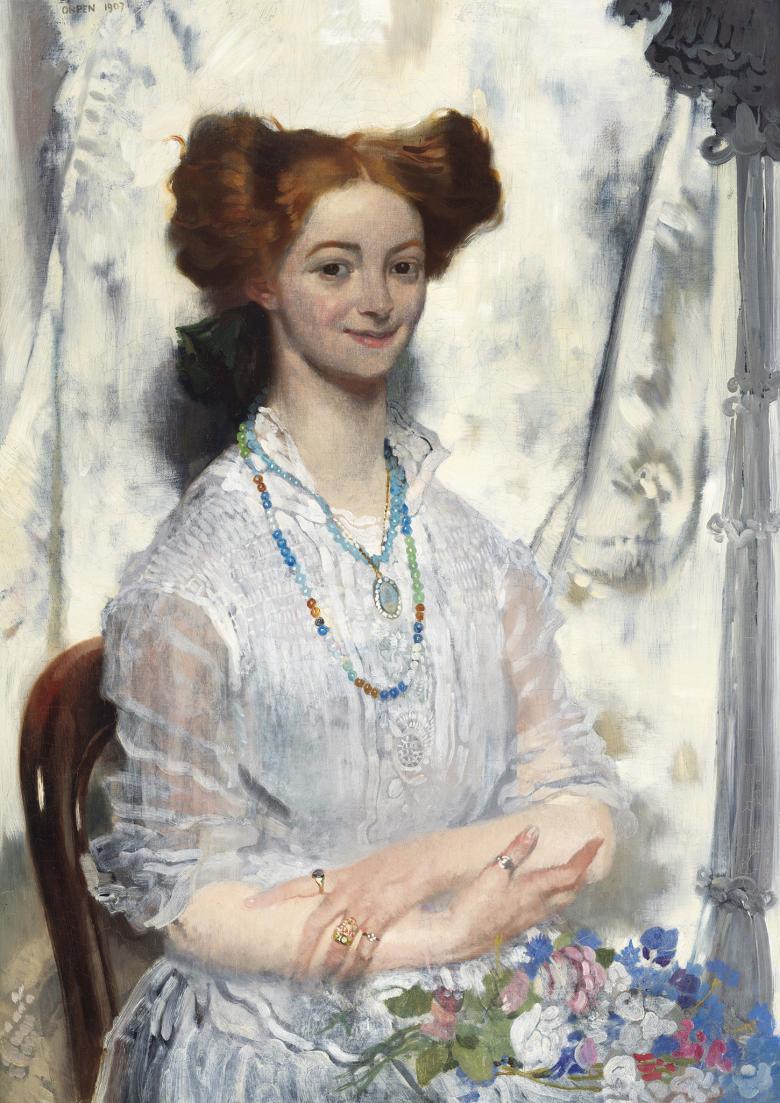
An important new addition to our Irish collection, Young Ireland by William Orpen, is now on display.
Grace Gifford, the subject of this painting, was an Irish cartoonist, caricaturist, illustrator, and, later, political activist. Born in Dublin in 1888, she attended the Dublin Metropolitan School of Art, where she studied under William Orpen from 1904-07. The pair developed a close friendship and Gifford was the subject of several works by Orpen, most notably this one.
Taking its title from the name of a political and cultural movement established in the 1840s by a group of Irish intellectuals committed to realising an independent Ireland, this painting presents Gifford as the personification of youthful Irish confidence.
Orpen’s portrait, both in title and character, is strangely perceptive, anticipating the radical social and political changes that would take place in Ireland over the next two decades, and Gifford’s own involvement in those changes. She was a sister-in-law of one of the leaders of Easter Rising, Thomas MacDonagh, and married another, Joseph Mary Plunkett, in Kilmainham Gaol just hours before his execution. Gifford remained politically active, joining the Sinn Féin executive in 1917 and serving time in Kilmainham during the Civil War.
Young Ireland (1907) was bequeathed to the Gallery by Mary and Alan Hobart, 2025. See it in Room 16 on your next visit.
About William Orpen (1878-1931)
One of Ireland’s most accomplished and recognised artists, William Orpen studied at the Metropolitan School of Art in Dublin before moving on to the Slade School of Art in London. He established himself quickly in London as a much sought-after portrait painter among the upper echelons of society. He was appointed an Official War Artist in 1917, and travelled to the Western Front, an experience that had a traumatic and lasting effect on him. His war landscapes are among the more arresting records of the First World War.
Orpen’s relationship with Ireland was fitful and complicated, but fond. He taught at the Metropolitan School of Art, where he exercised a profound influence over his students. Orpen revolutionised art teaching there, in particular by introducing nude models to his life drawing classes. He was known to invest much time and care in his most hard-working students and greatly influenced the numerous artists that trained with him. These included Margaret Clarke (1884-1961), Seán Keating (1889-1977), and Grace Gifford (1888-1955).
Orpen was knighted in 1918, and elected a member of the Royal Academy the following year. He became the official painter of the Paris Peace Conference after World War I, for which he painted The Signing of the Peace Treaty at Versailles (1919–20). After the war, he maintained studios in Paris and London. His final years were marked by continuing critical success but poor health. He died in Clareville Grove, South Kensington, and was buried in Putney Cemetery.
You might also like:
-

The Bathing Hour, the Lido, Venice (1912)
A new acquisition by Sir John Lavery
-

Duft (1937), by Hannah Höch
A new acquisition by artist Hannah Höch expresses her melancholy

